
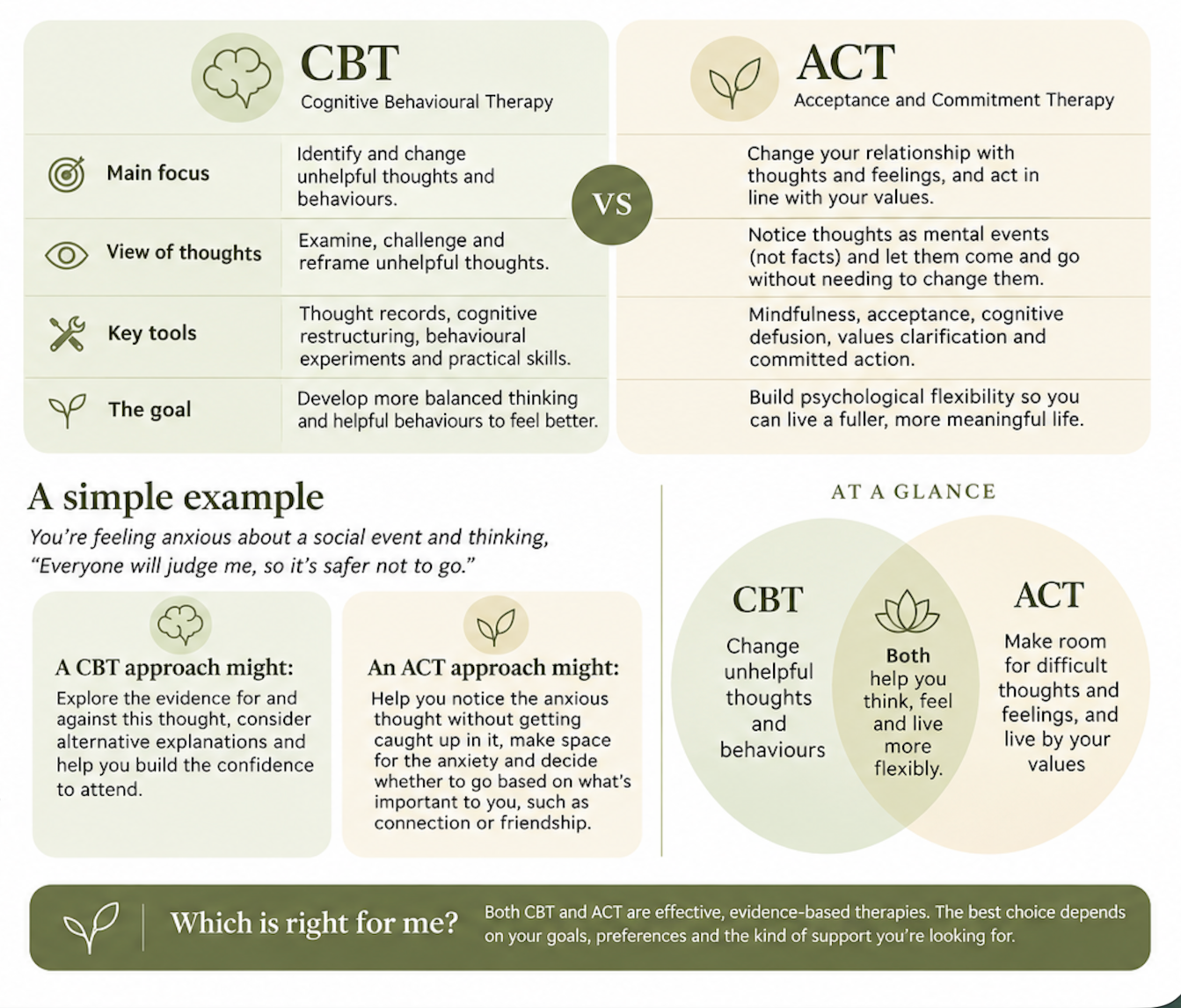
Two evidence-based approaches to therapy, with different ways of helping you manage difficult thoughts, emotions and behaviours.
You may be considering therapy, and you may have come across Cognitive Behavioural Therapy (CBT) and Acceptance and Commitment Therapy (ACT).
Both approaches can help people experiencing anxiety, depression, stress and other emotional difficulties. They share similar foundations, but differ in how they help us respond to challenging thoughts and feelings.
While CBT often focuses on identifying and changing unhelpful thinking patterns, ACT focuses on changing our relationship with those thoughts, allowing us to live more fully even when difficult emotions are present.
Understanding these differences may help you decide which approach feels right for you.
What is Cognitive Behavioural Therapy (CBT)?
Cognitive Behavioural Therapy, commonly known as CBT, is a structured, evidence-based psychological therapy that explores the connection between our thoughts, feelings and behaviours.
The underlying principle is that the way we interpret situations can influence how we feel and respond.
For example, imagine you've applied for a job but haven't received a response. You might immediately think:
“They haven’t replied to me because I’m not good enough.”
This thought could lead to feelings of disappointment, anxiety or low self-worth. You might then avoid applying for other jobs because you're afraid of being rejected again.
A CBT therapist would help you recognise this pattern and explore whether your interpretation is accurate or helpful.
You might also consider alternative explanations together, such as the employer still reviewing applications or having received a large number of candidates.
Through techniques such as cognitive restructuring, behavioural experiments and practical exercises, CBT helps people develop more balanced thinking patterns and change behaviours that may be continuing their difficulties.
What is Acceptance and Commitment Therapy (ACT)?
Acceptance and Commitment Therapy, is an evidence-based approach often described as part of the third wave of CBT.
Rather than focusing primarily on changing the content of our thoughts, ACT helps us develop a different relationship with them.
ACT recognises that difficult thoughts and uncomfortable emotions are a natural part of being human. Continually trying to suppress, avoid or control these experiences can sometimes make life more restrictive and overwhelming.
Instead, ACT encourages us to acknowledge our internal experiences without allowing them to dictate our actions.
Returning to our job application example, an ACT therapist might help you recognise the thought:
"I'm not good enough."
Rather than trying to prove the thought wrong, you might practise observing it:
"I'm noticing that I'm having the thought that I'm not good enough."
This subtle shift is called cognitive defusion. It helps create distance between ourselves and our thoughts, so we don't automatically treat everything our mind tells us as fact.
ACT also places considerable importance on personal values. If career development, independence or personal growth matters to you, therapy might help you continue applying for jobs even when feelings of self-doubt are present.
The aim isn't necessarily to eliminate uncomfortable feelings, but to develop the psychological flexibility to live meaningfully alongside them and to allow them not to rule over you.
A real-life example: Managing social anxiety
Imagine you've been invited to a social gathering, but you're worried that other people will judge you.
You find yourself thinking:
"Nobody will want to talk to me. I'll embarrass myself."
A CBT therapist might help you examine the evidence behind these predictions, consider more balanced explanations and gradually build your confidence through social experiences.
An ACT therapist might encourage you to notice these anxious thoughts without becoming entangled in them. You could then explore whether attending the gathering aligns with your values, such as friendship, connection and belonging.
In both cases, you may eventually feel more confident in social situations. However, the approaches differ in how they help you respond to your anxiety.
Which therapy is right for me?
There isn't one therapy that works best for everyone and some exploration and trial and error is necessary.
CBT may appeal to you if you prefer a structured, practical approach that helps you recognise unhelpful thinking patterns, challenge beliefs and develop new coping strategies.
ACT may appeal to you if you find yourself constantly battling difficult thoughts or emotions, or if you'd like to develop greater acceptance, psychological flexibility and a stronger connection to your personal values.
Both therapies have a strong evidence base, although the strength of evidence varies depending on the condition being treated. They also share many techniques, and some therapists incorporate elements of both into their work.
Ultimately, finding a therapist you feel comfortable with, who understands your difficulties and works collaboratively with you, is an important part of the process.
Exploring CBT or ACT in Dorchester
At The Rooms Poundbury, we bring together independent practitioners offering a range of psychological therapies and approaches to emotional wellbeing.
If you're considering therapy in Dorchester or the surrounding Dorset area, you can explore our practitioners' profiles to learn more about their experience, therapeutic approaches and areas of specialism.
Understanding the different types of therapy is a useful starting point, but you don't need to know exactly which approach is right for you before making an enquiry.